
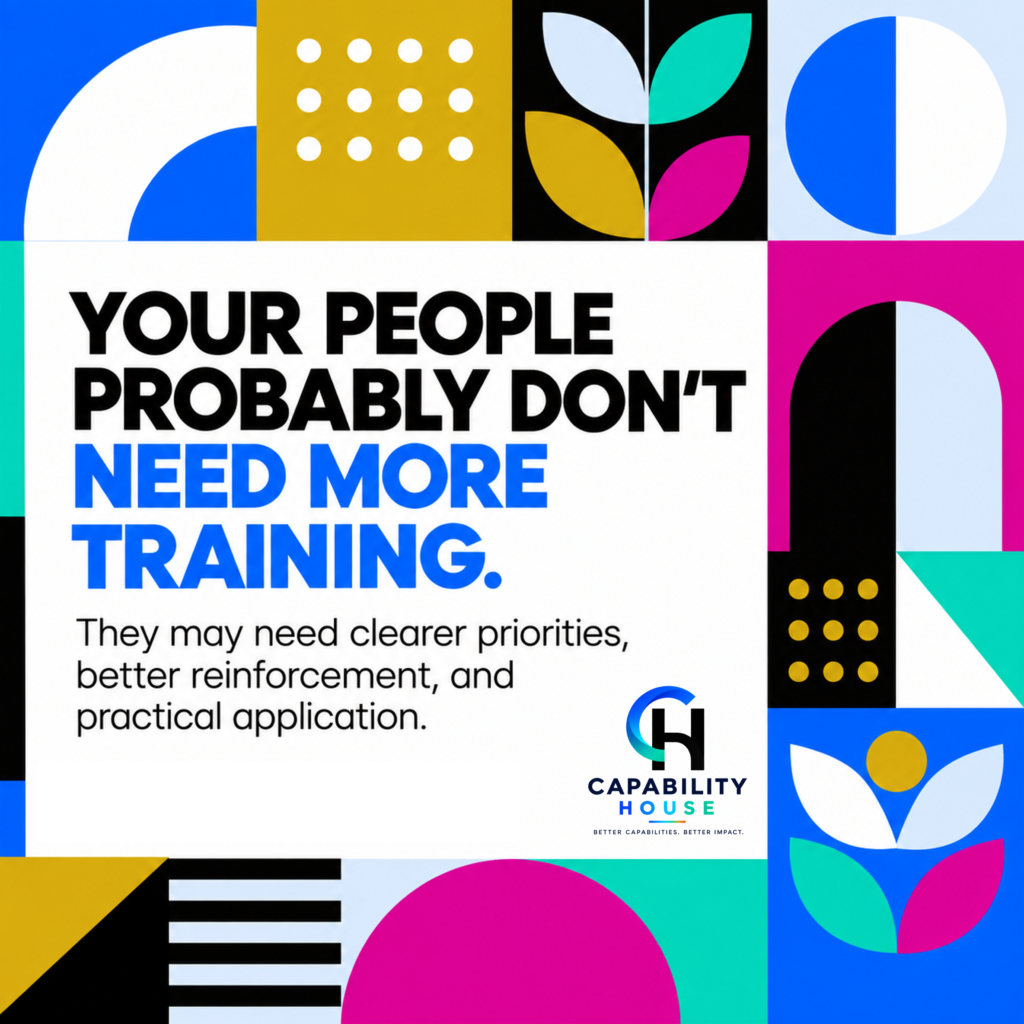
The uncomfortable truth? Sometimes training is just an expensive way of avoiding the real problem.
When performance drops, a familiar conversation starts:
“We need to upskill the team.”
“Managers need more training.”
“Sales need a refresher.”
“Can L&D build something?”
And sometimes, that is exactly the right answer.
But sometimes it isn’t.
Your people may already know what to do. The organisation just isn’t making it easy for them to do it.
At Capability House, we believe one of the most important questions to ask before designing any learning programme is deceptively simple:
Is this actually a capability problem?
Because if it isn’t, more training probably won’t fix it.
Training has become the corporate comfort blanket
Training is tangible. You can launch a programme, invite 100 people, measure attendance, collect satisfaction scores and report that something has been done.
The underlying problem is often messier.
People may understand the strategy but have seven competing priorities.
Managers may know how to coach but have no time to do it.
Salespeople may have attended negotiation training but are working within processes that reward short-term revenue over long-term value.
Leaders may understand how to give feedback but operate in a culture where difficult conversations are routinely avoided.
In all of these situations, another workshop can create activity without creating much change.
And the data gives us reason to question the system around learning.
LinkedIn’s 2025 Workplace Learning Report found that 50% of respondents said managers lacked the proper support for career development, while 45% said employees lacked support. Only 11% identified leaders not valuing career development as a top-three barrier.
That’s interesting. The desire may be there. The learning may even be there. The environment to apply it often isn’t.
Knowing isn’t the same as doing
This is where organisations can make an expensive mistake. They identify a gap in performance and assume there must be a corresponding gap in knowledge. But performance is influenced by much more than knowledge.
Ask:
Do people know what good looks like? If not → you may have a capability problem.
Do they know, but priorities keep changing? That’s potentially a clarity problem.
Do they know, but their manager doesn’t reinforce it? That’s potentially a management problem.
Do they know, but processes make the behaviour difficult? That’s potentially a systems problem.
Do they know, but there’s little consequence for ignoring it? That’s potentially an accountability problem.
As a Gallup’s Strengths expert I recently read some research which has long identified clarity of expectations as one of employees’ most fundamental needs, with effective managers continually helping people understand responsibilities, priorities and progress.
You can’t train your way out of unclear priorities.
So, should we stop investing in training?
Absolutely not.
The argument isn’t that training doesn’t work.
It’s that training works better when it’s solving the right problem.
And capability development itself is becoming more important, not less.
Nearly half (49%) of L&D and talent professionals surveyed by LinkedIn said their executives were concerned employees didn’t have the skills required to execute business strategy.
Organisations with mature career development practices also showed some striking differences. LinkedIn found they were 11 percentage points more likely to be confident about profitability, 17 points more likely to be confident about retaining talent, and 15 points ahead in leading or accelerating generative-AI adoption. These are associations rather than proof that learning alone caused the outcomes, but they’re still worth paying attention to.
And there’s an important clue in what the stronger organisations are doing differently.
It’s not just courses.
It’s leadership development, coaching, internal mobility, practical experience and opportunities to apply new capabilities. LinkedIn found career-development leaders were 88% more likely to offer project-based learning or career-enhancing gigs than organisations with less mature approaches.
That’s a very different proposition from:
“Everyone needs to complete this two-hour workshop by Friday.”
Before you commission another training programme, ask five questions
- What specifically do we need people to do differently?
- What’s stopping them doing it today?
- Is the gap knowledge, skill, motivation, clarity, process, leadership or something else?
- What needs to happen after the learning for the new behaviour to stick?
- What business measure should change if we get this right?
If those questions can’t be answered, designing the training may be premature.
Training shouldn’t be the starting point. The problem should be.
This philosophy sits at the heart of how we created Capability House.
Between us, we’ve spent years designing, delivering and leading learning, commercial capability, leadership and organisational development inside complex, fast-moving businesses.
And one lesson has stayed with us:
The best learning intervention is sometimes deciding not to build a learning intervention at all.
Sometimes the answer is coaching.
Sometimes it’s clearer expectations.
Sometimes it’s giving managers better tools.
Sometimes it’s changing the process.
Sometimes it’s practice, feedback and reinforcement.
And yes, sometimes it’s an outstanding training programme.
The important part is knowing the difference.
Because the objective shouldn’t be to deliver more learning.
It should be to build better capability and better performance.
Want to know whether you have a training problem or a performance problem?
At Capability House, we start with diagnosis before design. We work with organisations to understand what’s really getting in the way of performance and build practical capability solutions around it.
Talk to us about what your people and your business actually need.
Sources
LinkedIn — 2025 Workplace Learning Report
Gallup — Employees Want a Lot More From Their Managers
LinkedIn — Career Development and the Bottom Line