A stakeholder tells you, “My team needs training”. The temptation is to start looking for courses. It sounds like a clear brief. Leadership training. Sales training. Communication skills. AI upskilling.
But we think there is a better place to start: “What problem are we actually trying to solve?”
That distinction matters. Nearly half (49%) of L&D and talent professionals surveyed by LinkedIn in 2025 said their executives were concerned employees did not have the right skills to execute business strategy.
Skills clearly matter.
But identifying a performance problem and prescribing training are not the same thing.
Sometimes training is exactly what is needed. Sometimes the real barrier is the manager, the process, incentives, unclear expectations, tools or simply that people never get the opportunity to practise what they have learned.
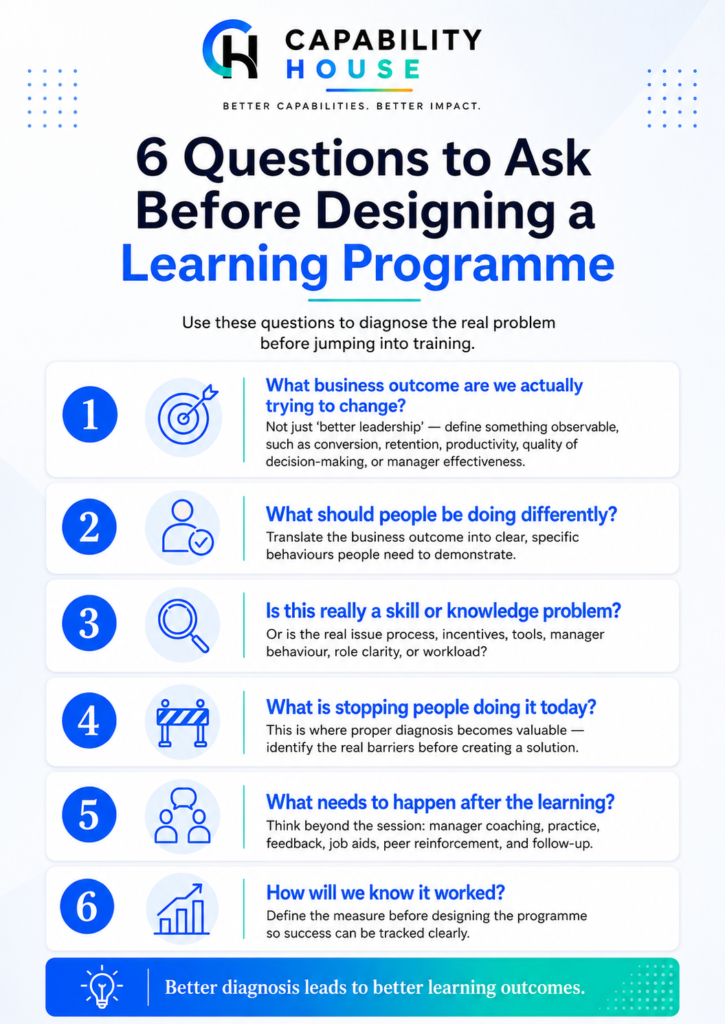
Before designing another programme, here are six questions we believe are worth asking.
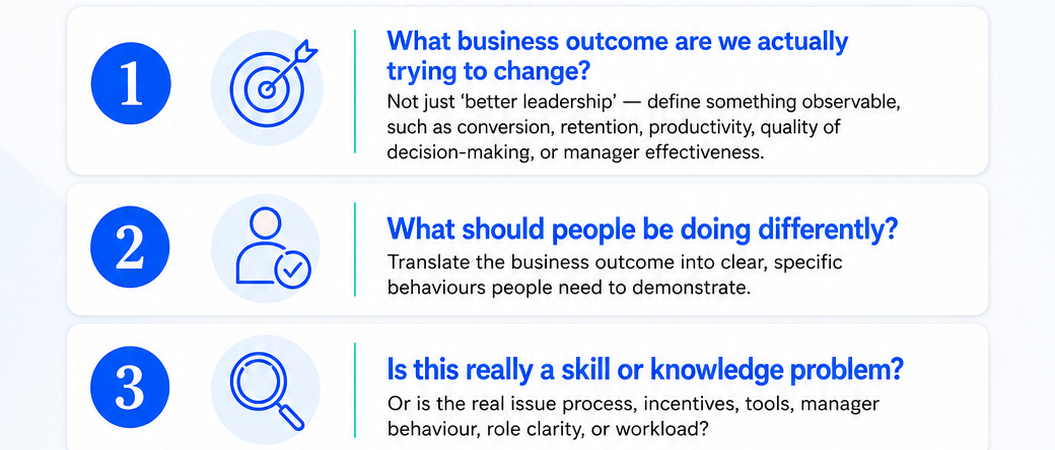
1. What business outcome are we actually trying to change?
“Develop better leaders” isn’t an outcome.
Neither is:
- improve communication
- build commercial capability
- increase confidence
Go one level deeper.
What would be different in the organisation if the programme worked?
Perhaps managers would make decisions faster. Salespeople would convert more opportunities. New managers would retain more of their team. Employees would use AI to reduce time spent on repetitive work.
A useful learning brief should therefore begin with something observable.
Instead of: “We need negotiation training.”
Try: “We are losing too many late-stage opportunities when procurement challenges our price.”
Now we have a business problem we can investigate.
2. What should people actually be doing differently?
Once you know the outcome, translate it into behaviour.
If the goal is better sales conversion, what does a strong performer actually do that others currently don’t?
Do they:
- ask different questions?
- identify stakeholders earlier?
- challenge the client’s brief?
- quantify value?
- handle objections differently?
- involve their manager sooner?
This is where learning starts becoming useful.
A broad capability such as commercial acumen is difficult to teach and even harder to measure.
A behaviour such as using business outcomes rather than product features to build the client case is something people can practise, observe and coach.
A simple test
Ask: “If I watched somebody doing their job, could I tell whether the behaviour had changed?”
If the answer is no, the learning objective probably needs more work.
3. Is this actually a skill problem?
This may be the most important question of all.
Imagine an employee already knows exactly how to do something but:
- the process makes it difficult,
- their manager rewards something different,
- their workload gives them no time,
- the system doesn’t support it,
- targets encourage the opposite behaviour,
- or nobody reinforces the new expectation afterwards.
Another workshop probably won’t solve that.
Research into training transfer (whether learning actually gets applied back at work) supports this. A major meta-analysis covering 89 empirical studies found positive relationships between transfer and factors including motivation and a supportive work environment. The relationship was particularly important for more open-ended capabilities such as leadership.
This is why we believe good learning design begins with diagnosis rather than content.
Before asking “What should we teach?”, ask:
“What is preventing this performance today?”
Sometimes the answer will be knowledge or skill.
Sometimes it won’t.
And recognising that early can save an organisation considerable time and money.
4. What is stopping people from doing it today?
Now the conversation gets interesting.
We like to look at the problem from several angles:
| Look at… | Ask… |
|---|---|
| Knowledge | Do people know what good looks like? |
| Skill | Can they actually do it? |
| Motivation | Do they see a reason to change? |
| Manager | Is the behaviour being coached and reinforced? |
| Process | Does the way work gets done support it? |
| Environment | Do people have the time, tools and opportunity? |
This prevents training becoming the default answer to every organisational problem.
It also means that when training is the answer, we can design it much more precisely.
5. What needs to happen after the learning?
This is where many programmes quietly fail.
The workshop finishes. Feedback is excellent. Everyone returns to work.
And Monday morning arrives.
Research suggests what happens around the learning matters significantly. One meta-analysis examining workplace support found that peer, supervisor and organisational support together accounted for 32% of the variation in training transfer, with peer and supervisor support especially important for sustaining learning.
The challenge is visible in current workplace data too. LinkedIn’s 2025 research found 50% of talent professionals identified insufficient manager support as one of the biggest barriers to career development.
So we believe programme design should include the environment people return to.
That might mean:
manager coaching questions, practical job aids, peer practice, live opportunities to apply the skill, feedback, follow-up challenges or reinforcement inside existing team meetings.
It doesn’t necessarily mean adding months of additional training.
It means creating a bridge between learning something and using it.
We call this The Monday Test
Before signing off a programme, ask: What will participants actually do differently when they return to work on Monday?
And then: What will help them keep doing it three months later?
If those questions don’t have clear answers, the programme probably isn’t ready.
6. How will we know it worked?
Attendance is useful.
Completion rates are useful.
Participant satisfaction is useful.
But none of them necessarily tell us whether capability changed.
Measurement should return to the original business problem.
If the objective was sales effectiveness, perhaps we look at conversion, pipeline progression, manager observations or quality of client conversations.
For managers, it may be employee feedback, behaviour assessments, retention or team performance.
For AI capability, it might be adoption, time saved, quality improvements or new workflows implemented.
The measure doesn’t always need to be sophisticated.
It just needs to answer:
Did something meaningful change?
And ideally, that question is decided before the programme begins, not after somebody asks for an ROI slide.
From training request to performance solution
Perhaps the biggest shift is a simple one.
| Instead of asking… | Try asking… |
|---|---|
| What training should we run? | What needs to change? |
| What content should we cover? | What behaviour do we need? |
| What course should we buy? | What is preventing performance? |
| Did people enjoy it? | Did people use it? |
| How many people completed it? | What changed afterwards? |
| When should we run the next workshop? | What reinforcement is needed now? |
At Capability House, this is how we prefer to work.
We don’t start with a catalogue of courses. We start with the business challenge.
Because sometimes the right answer is an immersive learning programme.
Sometimes it’s manager coaching.
Sometimes it’s a practical tool, a change to the operating rhythm or targeted practice for one critical behaviour.
And sometimes the most useful thing a learning partner can say is:
“I don’t think training is the problem.”
That is the difference between delivering training and building capability.
The six questions to take into your next learning brief
1. What business outcome are we trying to change?
2. What should people be doing differently?
3. Is this actually a skill or knowledge problem?
4. What is preventing the behaviour today?
5. What needs to happen after the learning?
6. How will we know it worked?
And one final question:
What happens on Monday?
If your learning strategy can answer that, you’re already designing something much more likely to matter.