

- Your People Probably Don’t Need More Training
The uncomfortable truth? Sometimes training is just an expensive way of avoiding the real problem.
When performance drops, a familiar conversation starts:
“We need to upskill the team.”
“Managers need more training.”
“Sales need a refresher.”
“Can L&D build something?”And sometimes, that is exactly the right answer.
But sometimes it isn’t.
Your people may already know what to do. The organisation just isn’t making it easy for them to do it.
At Capability House, we believe one of the most important questions to ask before designing any learning programme is deceptively simple:
Is this actually a capability problem?
Because if it isn’t, more training probably won’t fix it.
Training has become the corporate comfort blanket
Training is tangible. You can launch a programme, invite 100 people, measure attendance, collect satisfaction scores and report that something has been done.
The underlying problem is often messier.
People may understand the strategy but have seven competing priorities.
Managers may know how to coach but have no time to do it.
Salespeople may have attended negotiation training but are working within processes that reward short-term revenue over long-term value.
Leaders may understand how to give feedback but operate in a culture where difficult conversations are routinely avoided.
In all of these situations, another workshop can create activity without creating much change.
And the data gives us reason to question the system around learning.
LinkedIn’s 2025 Workplace Learning Report found that 50% of respondents said managers lacked the proper support for career development, while 45% said employees lacked support. Only 11% identified leaders not valuing career development as a top-three barrier.
That’s interesting. The desire may be there. The learning may even be there. The environment to apply it often isn’t.
Knowing isn’t the same as doing
This is where organisations can make an expensive mistake. They identify a gap in performance and assume there must be a corresponding gap in knowledge. But performance is influenced by much more than knowledge.
Ask:
Do people know what good looks like? If not → you may have a capability problem.
Do they know, but priorities keep changing? That’s potentially a clarity problem.
Do they know, but their manager doesn’t reinforce it? That’s potentially a management problem.
Do they know, but processes make the behaviour difficult? That’s potentially a systems problem.
Do they know, but there’s little consequence for ignoring it? That’s potentially an accountability problem.
As a Gallup’s Strengths expert I recently read some research which has long identified clarity of expectations as one of employees’ most fundamental needs, with effective managers continually helping people understand responsibilities, priorities and progress.
You can’t train your way out of unclear priorities.
So, should we stop investing in training?
Absolutely not.
The argument isn’t that training doesn’t work.
It’s that training works better when it’s solving the right problem.
And capability development itself is becoming more important, not less.
Nearly half (49%) of L&D and talent professionals surveyed by LinkedIn said their executives were concerned employees didn’t have the skills required to execute business strategy.
Organisations with mature career development practices also showed some striking differences. LinkedIn found they were 11 percentage points more likely to be confident about profitability, 17 points more likely to be confident about retaining talent, and 15 points ahead in leading or accelerating generative-AI adoption. These are associations rather than proof that learning alone caused the outcomes, but they’re still worth paying attention to.
And there’s an important clue in what the stronger organisations are doing differently.
It’s not just courses.
It’s leadership development, coaching, internal mobility, practical experience and opportunities to apply new capabilities. LinkedIn found career-development leaders were 88% more likely to offer project-based learning or career-enhancing gigs than organisations with less mature approaches.
That’s a very different proposition from:
“Everyone needs to complete this two-hour workshop by Friday.”
Before you commission another training programme, ask five questions
- What specifically do we need people to do differently?
- What’s stopping them doing it today?
- Is the gap knowledge, skill, motivation, clarity, process, leadership or something else?
- What needs to happen after the learning for the new behaviour to stick?
- What business measure should change if we get this right?
If those questions can’t be answered, designing the training may be premature.
Training shouldn’t be the starting point. The problem should be.
This philosophy sits at the heart of how we created Capability House.
Between us, we’ve spent years designing, delivering and leading learning, commercial capability, leadership and organisational development inside complex, fast-moving businesses.
And one lesson has stayed with us:
The best learning intervention is sometimes deciding not to build a learning intervention at all.
Sometimes the answer is coaching.
Sometimes it’s clearer expectations.
Sometimes it’s giving managers better tools.
Sometimes it’s changing the process.
Sometimes it’s practice, feedback and reinforcement.
And yes, sometimes it’s an outstanding training programme.
The important part is knowing the difference.
Because the objective shouldn’t be to deliver more learning.
It should be to build better capability and better performance.
Want to know whether you have a training problem or a performance problem?
At Capability House, we start with diagnosis before design. We work with organisations to understand what’s really getting in the way of performance and build practical capability solutions around it.
Talk to us about what your people and your business actually need.
Sources
LinkedIn — 2025 Workplace Learning Report
Gallup — Employees Want a Lot More From Their Managers
LinkedIn — Career Development and the Bottom Line - Before You Book Another Training Program: 6 Questions to Ask First
A stakeholder tells you, “My team needs training”. The temptation is to start looking for courses. It sounds like a clear brief. Leadership training. Sales training. Communication skills. AI upskilling.
But we think there is a better place to start: “What problem are we actually trying to solve?”
That distinction matters. Nearly half (49%) of L&D and talent professionals surveyed by LinkedIn in 2025 said their executives were concerned employees did not have the right skills to execute business strategy.
Skills clearly matter.
But identifying a performance problem and prescribing training are not the same thing.
Sometimes training is exactly what is needed. Sometimes the real barrier is the manager, the process, incentives, unclear expectations, tools or simply that people never get the opportunity to practise what they have learned.
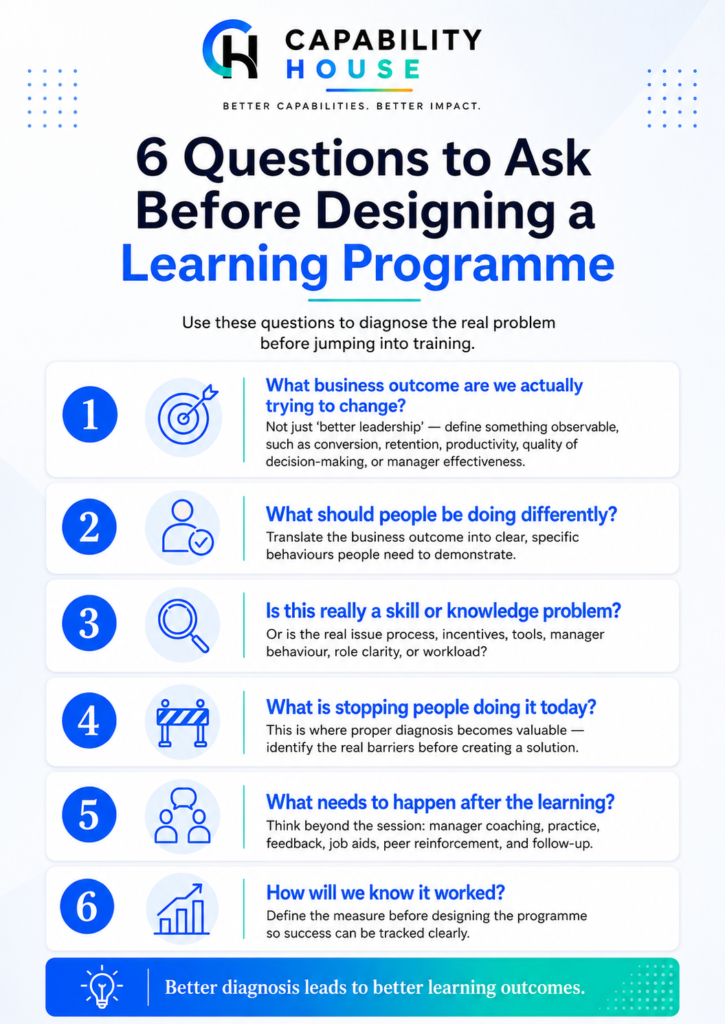
Before designing another programme, here are six questions we believe are worth asking.
1. What business outcome are we actually trying to change?
“Develop better leaders” isn’t an outcome.
Neither is:
- improve communication
- build commercial capability
- increase confidence
Go one level deeper.
What would be different in the organisation if the programme worked?
Perhaps managers would make decisions faster. Salespeople would convert more opportunities. New managers would retain more of their team. Employees would use AI to reduce time spent on repetitive work.
A useful learning brief should therefore begin with something observable.
Instead of: “We need negotiation training.”
Try: “We are losing too many late-stage opportunities when procurement challenges our price.”
Now we have a business problem we can investigate.
2. What should people actually be doing differently?
Once you know the outcome, translate it into behaviour.
If the goal is better sales conversion, what does a strong performer actually do that others currently don’t?
Do they:
- ask different questions?
- identify stakeholders earlier?
- challenge the client’s brief?
- quantify value?
- handle objections differently?
- involve their manager sooner?
This is where learning starts becoming useful.
A broad capability such as commercial acumen is difficult to teach and even harder to measure.
A behaviour such as using business outcomes rather than product features to build the client case is something people can practise, observe and coach.
A simple test
Ask: “If I watched somebody doing their job, could I tell whether the behaviour had changed?”
If the answer is no, the learning objective probably needs more work.
3. Is this actually a skill problem?
This may be the most important question of all.
Imagine an employee already knows exactly how to do something but:
- the process makes it difficult,
- their manager rewards something different,
- their workload gives them no time,
- the system doesn’t support it,
- targets encourage the opposite behaviour,
- or nobody reinforces the new expectation afterwards.
Another workshop probably won’t solve that.
Research into training transfer (whether learning actually gets applied back at work) supports this. A major meta-analysis covering 89 empirical studies found positive relationships between transfer and factors including motivation and a supportive work environment. The relationship was particularly important for more open-ended capabilities such as leadership.
This is why we believe good learning design begins with diagnosis rather than content.
Before asking “What should we teach?”, ask:
“What is preventing this performance today?”
Sometimes the answer will be knowledge or skill.
Sometimes it won’t.
And recognising that early can save an organisation considerable time and money.
4. What is stopping people from doing it today?
Now the conversation gets interesting.
We like to look at the problem from several angles:
Look at… Ask… Knowledge Do people know what good looks like? Skill Can they actually do it? Motivation Do they see a reason to change? Manager Is the behaviour being coached and reinforced? Process Does the way work gets done support it? Environment Do people have the time, tools and opportunity? This prevents training becoming the default answer to every organisational problem.
It also means that when training is the answer, we can design it much more precisely.
5. What needs to happen after the learning?
This is where many programmes quietly fail.
The workshop finishes. Feedback is excellent. Everyone returns to work.
And Monday morning arrives.
Research suggests what happens around the learning matters significantly. One meta-analysis examining workplace support found that peer, supervisor and organisational support together accounted for 32% of the variation in training transfer, with peer and supervisor support especially important for sustaining learning.
The challenge is visible in current workplace data too. LinkedIn’s 2025 research found 50% of talent professionals identified insufficient manager support as one of the biggest barriers to career development.
So we believe programme design should include the environment people return to.
That might mean:
manager coaching questions, practical job aids, peer practice, live opportunities to apply the skill, feedback, follow-up challenges or reinforcement inside existing team meetings.
It doesn’t necessarily mean adding months of additional training.
It means creating a bridge between learning something and using it.
We call this The Monday Test
Before signing off a programme, ask: What will participants actually do differently when they return to work on Monday?
And then: What will help them keep doing it three months later?
If those questions don’t have clear answers, the programme probably isn’t ready.
6. How will we know it worked?
Attendance is useful.
Completion rates are useful.
Participant satisfaction is useful.
But none of them necessarily tell us whether capability changed.
Measurement should return to the original business problem.
If the objective was sales effectiveness, perhaps we look at conversion, pipeline progression, manager observations or quality of client conversations.
For managers, it may be employee feedback, behaviour assessments, retention or team performance.
For AI capability, it might be adoption, time saved, quality improvements or new workflows implemented.
The measure doesn’t always need to be sophisticated.
It just needs to answer:
Did something meaningful change?
And ideally, that question is decided before the programme begins, not after somebody asks for an ROI slide.
From training request to performance solution
Perhaps the biggest shift is a simple one.
Instead of asking… Try asking… What training should we run? What needs to change? What content should we cover? What behaviour do we need? What course should we buy? What is preventing performance? Did people enjoy it? Did people use it? How many people completed it? What changed afterwards? When should we run the next workshop? What reinforcement is needed now? At Capability House, this is how we prefer to work.
We don’t start with a catalogue of courses. We start with the business challenge.
Because sometimes the right answer is an immersive learning programme.
Sometimes it’s manager coaching.
Sometimes it’s a practical tool, a change to the operating rhythm or targeted practice for one critical behaviour.
And sometimes the most useful thing a learning partner can say is:
“I don’t think training is the problem.”
That is the difference between delivering training and building capability.
The six questions to take into your next learning brief
1. What business outcome are we trying to change?
2. What should people be doing differently?
3. Is this actually a skill or knowledge problem?
4. What is preventing the behaviour today?
5. What needs to happen after the learning?
6. How will we know it worked?And one final question:
What happens on Monday?
If your learning strategy can answer that, you’re already designing something much more likely to matter.
If you would like to speak more about what happens Monday for your team get in touch! - Future Ready Sales Workforces Not One Off Trainings
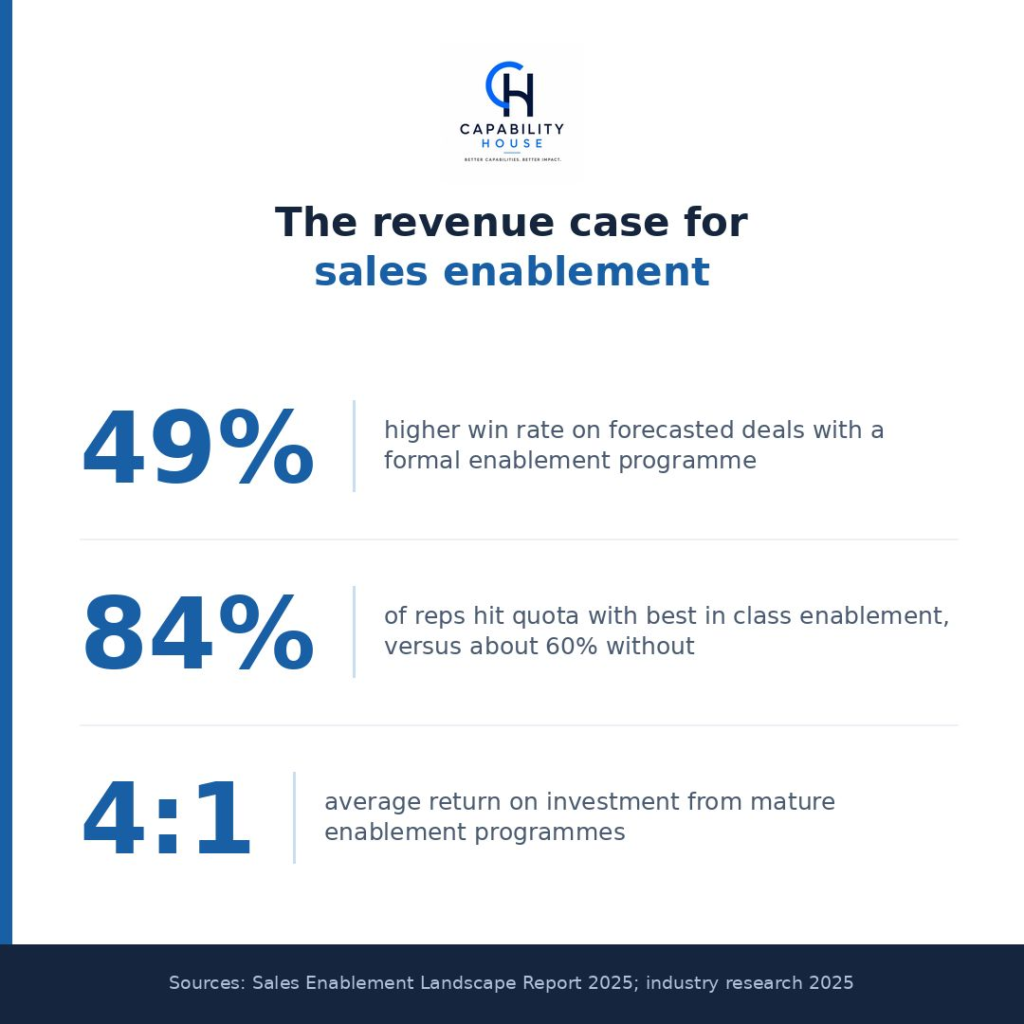
Most sales training does not stick. Here is why. It is delivered as an event, not built as a capability.
A team spends two days in a room, learns a framework, feels motivated, and then returns to the same pipeline, the same manager, the same incentives, and the same impossible week. Within a month, almost none of it survives.
Real sales enablement is not a workshop. It is a system.
It connects the skill to the actual deals in the pipeline. It equips managers to coach, not just reps to perform. And it is reinforced in the rhythm of how the team already works.
If your numbers are not moving, the answer is rarely another training day. It is looking honestly at the system your team is selling inside of.
That is the difference between training and enablement. And it is where we spend much of our time.
Sales enablement is one of our six practice areas at Capability House. If you would like to speak about it get in touch through LinkedIn or via our website. - How to Build an AI Training Roadmap for Your Organisation
Everyone is talking about AI skills. Very few organisations are building them properly.
Most efforts fall into one of two traps. Either a one off workshop that excites people for a week and then fades. Or a free for all, where a handful of self starters race ahead and everyone else quietly falls behind.
Neither builds lasting capability.
Here is what actually works.
Start with the work, not the tool. Identify where AI genuinely changes how a specific role operates, then build capability around that, not around generic prompt tips.
Equip the managers first. If team leaders cannot use AI with confidence, their teams never will. Capability spreads through managers, not memos.
Make it role specific. What a marketer needs from AI is not what a finance lead needs. Generic training is why generic results follow.
Build it into the rhythm of work. Capability that is not reinforced in how people already operate disappears within weeks.
AI capability is not about turning everyone into a technologist. It is about helping capable people do their actual jobs meaningfully better.
That is the work we do at Capability House, across professional development and marketing capability.
If your organisation is ready to move past the pilot stage, it is worth a conversation.Get in touch via LinkedIn or via our website

- How to Develop First-Time Managers After Promotion

Strong Performers Need More Than Just A New Title. The fastest way to lose your best people is to promote them.
It sounds backwards. But it happens constantly.
You take your strongest individual performer, the best salesperson, the sharpest analyst, the most reliable manager, and you reward them with a bigger role. More scope. More people. More complexity.
And then you leave them to figure it out.
The skills that made them excellent in the last role are not the skills the new one demands. Being brilliant at the work is not the same as leading the people who do the work. Nobody built that capability in them. We just assumed it would appear.
So they struggle quietly. Their team feels it. Their confidence drops. And eventually, the person you most wanted to keep starts looking elsewhere.
This is not a talent problem. It is a capability problem.
The organisations that hold on to their best people are the ones that build leadership capability deliberately, before the promotion, not years after it.
That is the work we do at Capability House.
If you have watched a strong performer struggle in a bigger role, you already know exactly what we mean.
#LeadershipDevelopment #CapabilityHouse #TalentRetention #Dubai